Price skimming strategy examples show how businesses can launch new products at high prices and gradually reduce them over time. This approach is commonly used when a product is innovative, has strong initial demand, or offers features that competitors cannot easily match.
What Is a Price Skimming Strategy?
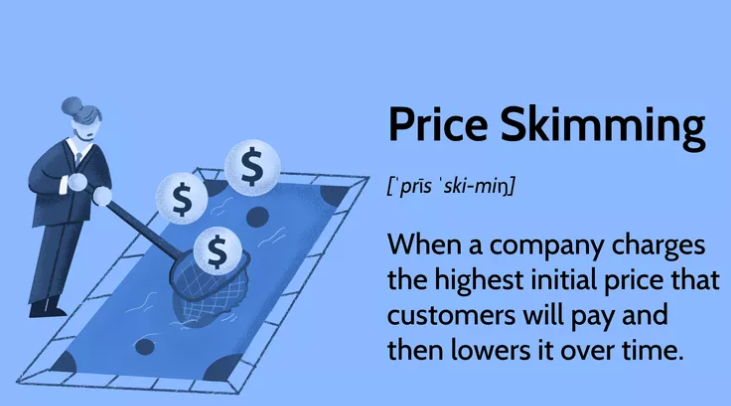
Price skimming is a pricing method in which a business initially sets a relatively high price for a new product or service. The company then lowers the price in stages as the product moves through its market life cycle.
The strategy is designed to capture revenue from different customer groups. Early buyers may be willing to pay more because they want the newest product, while later customers may only purchase after the price becomes more affordable.
For example, a technology company could launch a new smartphone for $1,200. After several months, it might reduce the price to $1,000 and later to $800. Each price level targets customers with different levels of willingness to pay.
How Price Skimming Works
Price skimming generally follows several stages:
- Premium launch price: The product enters the market at a high price.
- Early-adopter sales: Customers who value innovation purchase the product first.
- Gradual price reductions: The company lowers the price to reach additional customers.
- Broader market adoption: More price-sensitive consumers become potential buyers.
- Later-stage pricing: The product eventually reaches a more competitive price.
This process allows a company to earn higher margins during the early stages while gradually expanding its customer base.
Price Skimming Strategy Examples
1. Smartphones
Smartphones are one of the clearest examples of price skimming. New flagship devices often enter the market at premium prices because some customers want the latest processor, camera system, display, or other technology immediately.
As newer models are introduced, previous devices can become cheaper. This allows manufacturers and retailers to reach customers who were unwilling to pay the original launch price.
2. Gaming Consoles
New gaming consoles can also use elements of price skimming. Early adopters may purchase a new console soon after launch despite its relatively high price because they want access to new hardware and games.
Over time, discounts, bundles, and newer models can make the original console more accessible to a wider audience.
3. Consumer Electronics
Televisions, laptops, cameras, and other electronics can follow a similar pricing pattern.
A newly released device may initially cost significantly more because it contains recently introduced technology. Once competing products appear and production becomes more efficient, the price may decline.
4. Electric Vehicles
Some electric vehicle manufacturers have targeted premium customers with technologically advanced models before expanding toward less expensive segments.
The initial premium positioning can help companies generate revenue while developing manufacturing capacity and improving their technology.
5. Pharmaceuticals
Pharmaceutical pricing can sometimes resemble price skimming because newly introduced medicines may have relatively high prices during periods of market exclusivity.
However, pharmaceutical pricing is more complicated than ordinary consumer-product pricing because regulations, insurance systems, patents, negotiations, and healthcare policies can significantly affect the final price.
Why Businesses Use Price Skimming
Businesses may choose price skimming for several reasons.
Recover Development Costs
New products can require substantial investment in research, development, manufacturing, and marketing. A higher initial price can help businesses recover some of these costs more quickly.
Target Early Adopters
Some customers are less sensitive to price and more interested in getting a new product as soon as possible. Price skimming allows companies to capture revenue from this group.
Build a Premium Image
A high launch price can position a product as innovative or premium. This can be particularly useful for brands competing in technology, luxury, and specialized markets.
Increase Initial Profit Margins
When demand is strong, a higher initial price can generate greater margins than launching at a low price immediately.
Reach Different Customer Segments
Gradual price reductions allow businesses to sell the same product to customers with different budgets and willingness to pay.
Advantages of Price Skimming
Price skimming can provide several benefits when market conditions support it.
Higher early revenue: A premium launch price can generate substantial revenue from early buyers.
Faster cost recovery: Companies may recover development and launch expenses more quickly.
Premium positioning: Higher prices can reinforce the perception that a product is innovative or exclusive.
Flexible pricing: Businesses can reduce prices later as market conditions change.
Market segmentation: Different price levels can attract different groups of customers.
Disadvantages of Price Skimming
Price skimming also has potential drawbacks.
Limited initial market: A high price can prevent many consumers from buying the product.
Competition: Competitors may introduce cheaper alternatives and take market share.
Customer dissatisfaction: Early buyers may feel frustrated when the price falls shortly after they purchase.
Requires strong demand: The strategy works best when enough customers are willing to pay a premium.
Brand perception risks: Repeated price reductions may make customers question whether they should purchase products at launch.
Price Skimming vs. Penetration Pricing
Price skimming and penetration pricing take opposite approaches.
| Feature | Price Skimming | Penetration Pricing |
|---|---|---|
| Initial price | High | Low |
| Main goal | Capture high-value demand | Gain market share |
| Early customers | Less price-sensitive | Price-sensitive |
| Price changes | Usually decreases | May increase later |
| Common use | Innovative or premium products | Highly competitive markets |
A company choosing between these strategies needs to consider its product, competitors, target customers, production costs, and long-term goals.
When Is Price Skimming Most Effective?
Price skimming is generally more suitable when a product has strong demand and meaningful differentiation.
It can work particularly well when:
- The product is innovative or technologically advanced.
- Early customers have a high willingness to pay.
- Competition is limited at launch.
- The business has a strong brand.
- Production costs are expected to decline.
- The product has distinct customer segments.
- Competitors cannot immediately offer comparable alternatives.
If customers can easily switch to cheaper alternatives, maintaining a high launch price can become difficult.
Final Thoughts
Price skimming strategy examples can be found across industries such as smartphones, gaming, consumer electronics, electric vehicles, and pharmaceuticals. The central idea is simple: start with a higher price to capture demand from customers willing to pay more, then gradually lower the price to reach additional market segments.
The strategy can be effective for innovative products with strong early demand, but businesses must carefully consider competition, customer expectations, and market conditions before adopting it.