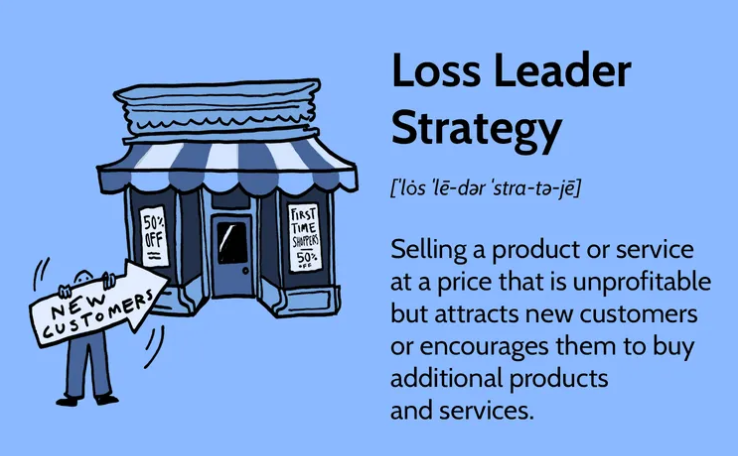
Loss leader pricing strategy is a pricing method in which a business deliberately offers a product at a very low price, sometimes below its cost, to attract customers and encourage additional purchases. Instead of expecting the discounted product itself to generate profit, the business aims to make money from other products or services purchased by the same customers.
This strategy is widely associated with supermarkets and retail stores, but businesses in industries such as gaming, electronics, ecommerce, subscriptions, and consumer goods can also use it. The key is to recover the initial margin sacrificed on the discounted product through additional sales or future purchases.
What Is a Loss Leader Pricing Strategy?
A loss leader pricing strategy involves selecting a product that customers find attractive and selling it at an unusually low price. The low price is designed to create interest, increase traffic, and encourage customers to purchase other products with higher profit margins.
For example, imagine a supermarket normally sells a product for $5 but advertises it for $3. If the store earns little or no profit on that product, it can still benefit if customers purchase other groceries during the same visit.
The important point is that the business evaluates the profitability of the overall customer transaction, rather than focusing only on the loss leader.
A successful strategy therefore depends on what customers do after purchasing the discounted item. If they buy additional products, the business may recover the initial loss and generate an overall profit.
How Loss Leader Pricing Works
The process is relatively straightforward.
1. Select an Attractive Product
The business chooses a product that customers already know, want, or regularly purchase. Common choices include groceries, electronics, household products, and products that require recurring purchases.
2. Reduce the Price
The selected product receives a significant discount. Depending on the strategy, the price may be close to cost or below cost.
3. Attract Customers
The low price is promoted through advertisements, websites, email campaigns, store displays, social media, or special offers.
4. Encourage Additional Purchases
Once customers arrive, businesses use product placement, recommendations, bundles, accessories, or related products to encourage additional spending.
5. Recover the Initial Loss
The business attempts to recover the money lost on the discounted product through higher-margin products purchased during the same transaction or through repeat purchases later.
Loss Leader Pricing Example
Consider a grocery store selling a popular brand of coffee.
The store normally sells the coffee for $10 but temporarily reduces the price to $7. Suppose the store makes little or no profit on the discounted coffee.
A customer visits specifically because of the $7 offer. While shopping, the customer also buys:
- Milk
- Sugar
- Biscuits
- Bread
- Cereal
- Snacks
The store may lose money or earn very little from the coffee, but the additional purchases can generate enough margin to make the entire transaction profitable.
This is the basic principle behind the loss leader model.
Common Loss Leader Pricing Examples
Supermarkets
Supermarkets frequently use popular grocery products as traffic drivers. Items such as milk, eggs, bread, and meat can attract customers because shoppers generally understand their typical prices.
A customer who enters a store for one discounted item may purchase several other products during the same visit.
Gaming Consoles
Gaming hardware can also function as a loss leader. A company may accept a low margin on the console because customers can later purchase games, accessories, subscriptions, controllers, and other products.
The initial hardware sale can therefore introduce customers to a larger product ecosystem.
Printers and Ink
Printers provide another familiar example. A printer may be sold at a relatively low price, while replacement ink and other consumables generate recurring revenue.
The initial product attracts the customer, while future purchases provide opportunities for additional revenue.
Razors and Replacement Blades
The razor-and-blade model works in a similar way. A company can offer the initial razor at an attractive price and generate revenue from replacement blades purchased repeatedly.
This model is particularly suitable for products where customers naturally need additional supplies.
Ecommerce Products
Online stores can use loss leaders to bring customers to their websites. A heavily discounted product can attract visitors through search results, advertisements, social media, or email promotions.
Once customers arrive, the store can recommend related products, bundles, accessories, or complementary items.
Benefits of Loss Leader Pricing Strategy
A loss leader pricing strategy can provide several potential benefits when it is carefully planned.
Increased Customer Traffic
A strong discount can attract people who might otherwise purchase from competitors. This can increase physical store visits as well as website traffic.
Higher Average Order Value
If customers purchase additional products alongside the loss leader, the business can increase its average order value.
Customer Acquisition
A low-cost introductory offer can help businesses acquire new customers. The business may accept a small initial loss if those customers make profitable purchases later.
Increased Product Awareness
A discounted product can introduce customers to a brand or product category they have not previously tried.
Inventory Movement
Businesses can sometimes use attractive pricing to increase the sales of products that are moving slowly or need to be cleared from inventory.
Repeat Purchases
The strategy can be especially useful for products that naturally lead to repeat purchases. If customers return regularly, the original discount may be recovered through future transactions.
Disadvantages of Loss Leader Pricing Strategy
Despite its potential benefits, this strategy also carries important risks.
Reduced Profit Margins
The most obvious disadvantage is the reduced margin on the loss leader. If additional purchases do not compensate for that reduction, the campaign can become unprofitable.
Bargain-Only Customers
Some customers may purchase only the discounted product and leave. These customers can create sales volume without generating enough profit to cover the discount.
This is sometimes referred to as attracting customers who are primarily interested in the deal.
Price Wars
Aggressive discounting can encourage competitors to reduce their prices as well. If several businesses continuously undercut each other, margins can decline across the market.
Brand Perception
Frequent deep discounts can potentially affect how customers perceive a brand. Customers may begin to associate the business primarily with low prices rather than quality or value.
Limited Suitability
Loss leader pricing works more naturally for businesses with complementary products, repeat purchases, subscriptions, or strong customer lifetime value.
A business selling only one low-margin product may have difficulty recovering the initial loss.
Regulatory Considerations
Below-cost pricing can also raise legal and competition-policy questions depending on the market and jurisdiction. In the United States, for example, the Federal Trade Commission distinguishes ordinary low pricing from predatory pricing intended to eliminate competitors and later recoup losses through higher prices.
Businesses should therefore consider the laws applicable to their specific market before using aggressive below-cost pricing.
Loss Leader Pricing vs. Predatory Pricing
These two concepts are sometimes confused because both can involve very low prices.
Loss leader pricing is generally intended to attract customers and stimulate additional profitable sales.
Predatory pricing, by contrast, involves pricing conduct intended to eliminate competitors or prevent competition, with the possibility of recovering losses later through higher prices. Competition authorities assess such conduct under applicable antitrust or competition laws.
The purpose and broader market circumstances are therefore important when evaluating below-cost pricing.
When Should a Business Use Loss Leader Pricing?
A business may consider a loss leader when it has a clear way to generate additional revenue from customers attracted by the offer.
It can be particularly useful when:
- The product has strong customer demand.
- Customers commonly purchase related products.
- The business has healthy margins on complementary products.
- Customers are likely to make repeat purchases.
- The business wants to acquire new customers.
- The company can track the profitability of the campaign.
- The discount can be limited to a specific period.
For example, an ecommerce business could discount a popular accessory while recommending higher-margin products during checkout.
How to Create a Successful Loss Leader Strategy
A business should not simply choose a product and reduce its price without calculating the potential outcome.
Choose the Right Product
The loss leader should have enough appeal to motivate customers to act. Products with strong demand and recognizable value are often easier to promote.
Identify Complementary Products
Before launching the offer, determine which products customers are likely to purchase alongside the discounted item.
Calculate the Margin
Calculate the actual cost of the discount and determine how much additional margin is needed to recover it.
Track Customer Behavior
Measure important metrics such as:
- Conversion rate
- Average order value
- Additional item purchases
- Repeat purchase rate
- Customer acquisition cost
- Customer lifetime value
- Overall campaign profit
Customer lifetime value is particularly important when the strategy depends on repeat purchases rather than immediate additional sales.
Set Limits
A business can limit the quantity each customer can purchase, restrict the promotion to certain dates, or use membership requirements. These controls can help prevent excessive losses.
A Simple Loss Leader Calculation
Suppose an online store sells a product for $20 and normally earns a $6 margin.
For a promotion, the store reduces the price to $14. The business therefore sacrifices $6 of expected margin per sale.
If customers attracted by the offer purchase another product with a $12 margin, the additional purchase can more than compensate for the sacrificed margin.
The calculation should not stop at the first product. Businesses need to examine the total contribution generated by customers acquired through the promotion.
This is why tracking customer behavior is essential to a loss leader pricing strategy.
Is Loss Leader Pricing Effective?
The effectiveness of loss leader pricing depends on the business model and customer behavior.
A discounted product by itself does not guarantee profitability. The strategy works when the additional revenue generated by attracted customers is sufficient to compensate for the reduced margin.
Businesses with recurring purchases, complementary products, subscriptions, or high customer lifetime value may have more opportunities to recover the initial loss.
For this reason, businesses should test the strategy on a limited scale before applying it broadly.
Final Thoughts
Loss leader pricing strategy is designed around a simple idea: accept a lower margin on one product to generate greater revenue from the customer relationship as a whole.
Supermarkets, gaming companies, electronics businesses, ecommerce stores, and other retailers can use this approach to attract customers and increase additional sales. However, the strategy only makes financial sense when the business has a realistic method for recovering the initial margin through other purchases or future customer activity.
The most important factors are product selection, complementary sales, customer behavior, margins, and customer lifetime value. When these factors are measured carefully, loss leader pricing can become a structured part of a broader pricing and customer-acquisition strategy rather than simply an aggressive discount.